How Patients Are Finding Dentistry Clinics in 2026, And Why Google Is No Longer the Only Answer
Sandy Adel
April 9, 2026 · 5 min read
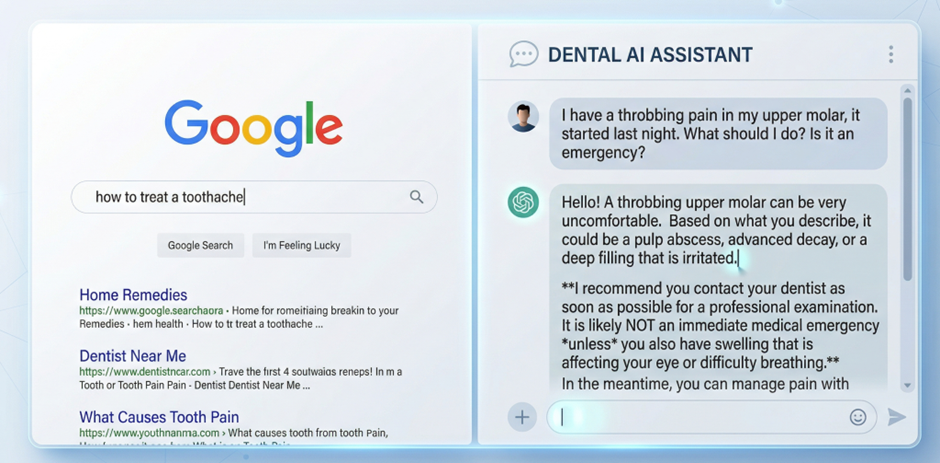
A patient in Melbourne decides she wants to replace a missing tooth. She does not type “dental implant clinic near me” into Google. She opens ChatGPT and asks: “What should I know before getting a dental implant, and how do I find a qualified dentist in Melbourne?” She gets a direct answer. A few clinics are mentioned by name. She shortlists two of them and books a consultation the next morning.That patient never saw your Google listing. She may never have visited your website at all.This is how a growing number of patients are researching dental care in 2026. The search journey has changed, and dental practices that rely entirely on traditional SEO are starting to notice the gap.
The Shift From Search Results to AI Answers
Google is not going away. It still handles billions of searches every day and remains the dominant discovery channel for most industries, including healthcare. But AI platforms like ChatGPT, Perplexity, and Google’s AI Overviews have changed what patients expect when they search.Instead of scanning a list of ten blue links and deciding which one to click, patients are increasingly getting a single synthesised answer that pulls from multiple sources. The AI does the shortlisting for them. By the time a patient reaches out to a clinic, they have often already been pre-filtered by an algorithm they never consciously interacted with.The clinics that appear in those AI-generated answers are not necessarily the ones with the best Google rankings. They are the ones whose content was structured clearly enough, attributed accurately enough, and detailed enough to be treated as a credible source.
What Dental Patients Are Actually Asking AI Tools
The questions patients ask AI platforms are different from the keywords they type into a search bar. Search engine queries tend to be short and location-based: “dentist Sydney CBD” or “teeth whitening cost Brisbane.” AI queries are more conversational and specific: “Is Invisalign suitable for crowded teeth in adults,” “how long does a root canal take and will it hurt,” or “what questions should I ask a cosmetic dentist before veneers.”These are research questions, not navigational ones. The patient is not yet looking for a specific clinic. They are building an understanding of the procedure, the process, and what to look for in a provider. If your website answers those questions clearly and accurately, it has a reasonable chance of being cited. If it does not, another source will be.The implication for dental practices is practical. Content that addresses real patient questions, written in plain language, structured with clear headings, and attributed to a named, qualified practitioner, performs better in this environment than a polished service page with a gallery and a generic tagline.
Compliance Is Standard, Not Optional
Dental practices in Australia, Singapore, and the United States already operate within established advertising frameworks, and this shapes how compliant content is written.
In Australia, AHPRA guidelines govern what dental practitioners can claim in their marketing. Testimonials from patients are not permitted, before-and-after images are tightly regulated, and absolute claims about outcomes are not acceptable. The TGA adds further requirements around therapeutic device advertising. In Singapore, the Singapore Dental Council and the Ministry of Health set the standards for how dental services can be promoted, with the HCSA providing a broader regulatory structure. In the United States, the FTC and ADA guidelines govern truth in advertising for dental practices.
Compliant content, by design, tends to be measured and factual. It explains what a procedure involves, who it is suitable for, and what the process looks like, without making promises about results. This kind of writing aligns closely with what AI tools treat as credible. The clinics that produce compliant content consistently are, in many cases, already producing the type of material that performs well in AI search, even if they have not thought about it that way.
What Dental Practices Can Do Right Now
The starting point is your procedure content. Most dental websites have a services page that lists treatments with a short paragraph on each. That structure was built for a different era. An AI tool cannot extract a meaningful answer from a three-sentence description of porcelain veneers. A well-written page that explains candidacy, the preparation process, what to expect during recovery, and how to choose a practitioner gives the model something to work with.The second area is FAQ content. Patients ask dental AI queries in question form, and content that mirrors that structure tends to get cited more consistently. Questions like “how many appointments does a dental implant require” or “what is the difference between composite and porcelain veneers” are exactly the kind of queries AI tools receive, and a practice that has answered them clearly and accurately on its website is in a strong position.Practitioner attribution matters more than most clinics expect. A page written and attributed to a named dentist with their registration details, qualifications, and areas of practice carries more weight in AI indexing than unsigned content. Author schema and structured data allow AI systems to verify who is behind the information, which affects how the content is treated as a source.Local signals still matter too. Schema markup that identifies your practice name, location, opening hours, and registered details connects your digital content to your physical presence in a way that AI tools can reference when patients ask location-specific questions.
Getting Your Dental Practice Found in AI Search
The practices that will be found consistently in AI-generated answers over the next few years are the ones building content now that is detailed, well-attributed, and structured to answer real patient questions. It is not a separate strategy from good marketing. It is what good marketing looks like in 2026.ContentClicks works with dental and healthcare practices across Australia, Singapore, and the United States to produce compliant, AEO-ready content that performs in both traditional search and AI-generated answers. If your practice’s content needs a rethink,get in touch with the team at ContentClicks.
A premium content marketing agency for businesses in regulated industries. Brands in healthcare, finance, legal and beyond partner with us to grow, because we know the standards these sectors are held to. We serve clients across Australia, the United States and Singapore.